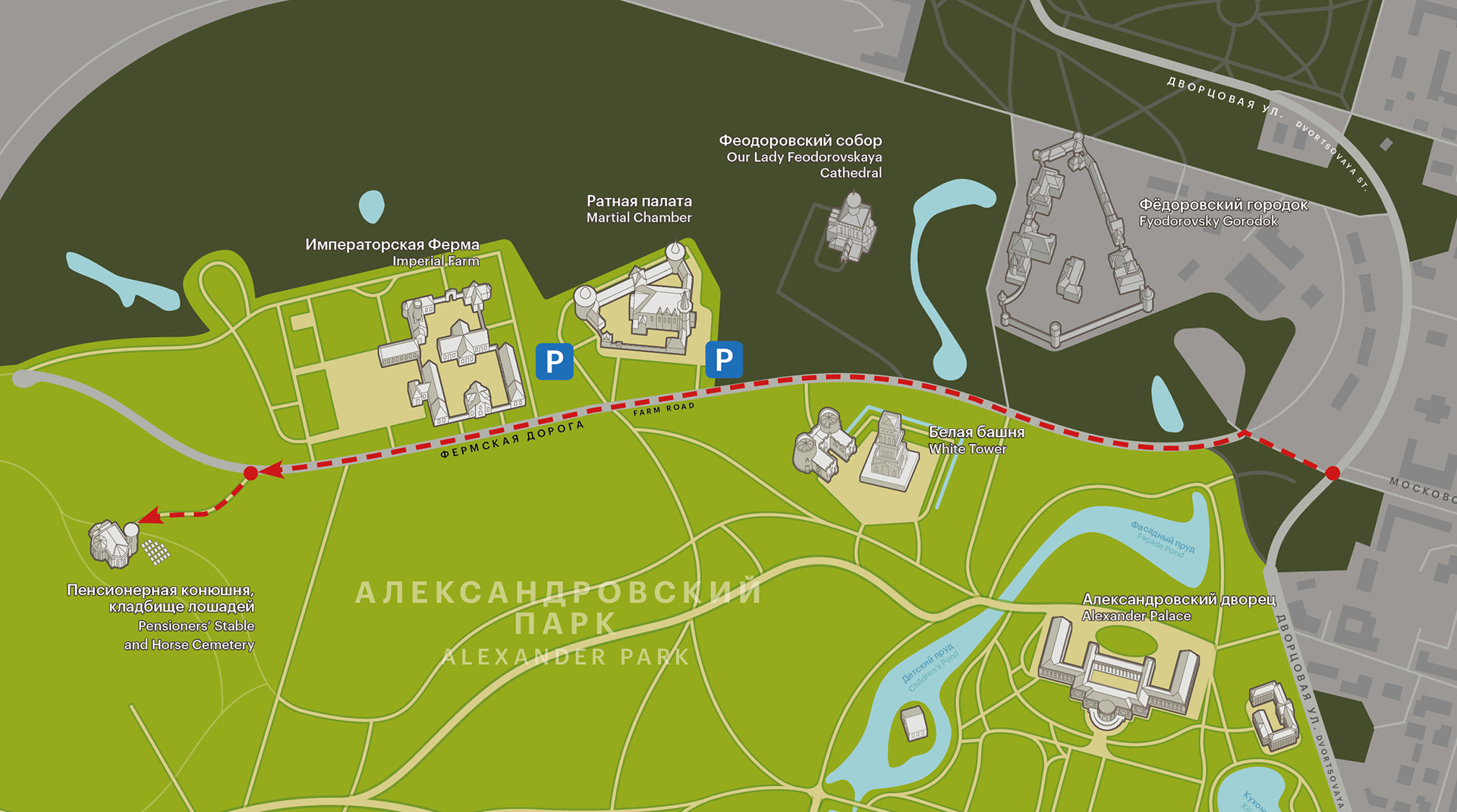
Restored last August, the nineteenth-century site of the Pensioners' Stable and Horse Cemetery in the Alexander Park of Tsarskoe Selo is now open as our new permanent display Tsar's Horses: Life after Service.
The exhibition is dedicated to horses at the Russian imperial court and the monarchs' influence on domestic horse breeding, with life stories of some famous imperial horses and their post-service retirement.
The two-storey Pensioners' Stable pavilion offers more than a hundred and twenty objects from the museum collection including paintings, horse harnesses, sculptures, prize cups, books, and fragments of old grave slabs from the adjacent world's largest Imperial Horse Cemetery.
The lower floor with information kiosks and four reconstructed stalls introduce the visitor to various horse breeds and their distinctive characteristics, as well as to some horses renowned in Russian and world history. Those themes are illustrated with such paintings as Emperor Nicholas I with His Retinue (1840) by Franz Krüger, Portrait of Nicholas II (1907) by Alexander Makovsky, Portrait of Adjutant General Georg von Meyendorff and Bay Horse by Alexander Schwabe, Courage by Pavel Kovalevsky, and several animalier bronzes by Joseph Yushkov.
The centerpiece in one of the rooms is a riding habit of Empress Alexandra Fёdorovna, the spouse of Emperor Nicholas I, reconstructed after Heinrich Schmidt's 1842 print Nicholas I and Alexandra Fёdorovna on Horseback and completed with a ladies saddle, stirrups and a whip from our collection.
Other artifacts include: authentic grave slabs of Nicholas I's and Alexander II's horse Ceres and Nicholas II's gray gelding Serko; a collection of spurs, stirrups and bits; a richly decorated harness of a donkey presented to Tsesarevich Alexei by King Victor Emmanuel III of Italy during Nicholas II's visit to Rome in 1909.
Some sections of the exhibition are devoted to: horse maintenance at the imperial stables; state agencies responsible for the horse breeding industry and imperial horse care; stud farms and horse breeding specialists in the Russian Empire; imperial horse burial traditions; horse training and equestrian competitions in Russia, illustrated with silver cups from the Naryshkin Treasure and books on horse training from the personal library of Nicholas I.
The upper floor houses a model of the Pensioners' Stable in the nineteenth century and a reconstructed interior of the caretaker's office. Caretakers were usually appointed from retired cavalry officers.
The new exhibition's opening ceremony on 28 April 2026 was attended by French writer and horse specialist Jean-Louis Gouraud, who financially supported some of the grave slabs' restoration in the early 2000s. The guest of honour said, The Pensioners' Stable and Horse Cemetery site is of great historical and architectural value. For me personally, it marks the boundary between two eras. In 1826, when Emperor Nicholas I issued a decree establishing the Pensioners' Stable and subsequently the Horse Cemetery, the decision might seem quite unusual. Even the first animal protection societies emerged only half a century afterwards. And it was much later that people began to talk about animal welfare and rights. So, in a sense, Nicholas I became the harbinger of a new era, an era of caring human interaction with the animal world.
Tsarskoe Selo thanks:
• the Horse Breeding Museum of Moscow's Timiryazev Agricultural Academy for assistance in the exhibition's development;
• the Svoya Shkola museum design bureau for the exhibition's design.